Ravenna, A Mecca For Mosaics

Updated: Jan 1

With the most spectacular collection of Byzantine mosaics anywhere, one might expect Ravenna to feature more prominently in tourist itineraries. The city sees its fair share of crowds – but not nearly as many as one might expect from the quality of its monuments. Visiting Ravenna’s seven mosaic-drenched interiors makes an exhilarating day, even for those leery of too many churches.
The UNESCO-listed sites are full of experimentation, as the Western world transitioned to a new era in politics, religion, and art.
Ravenna rose from a port city to capital of the western Roman Empire, then faded back into relative obscurity. This helped its monuments survive without the looting or remodeling that ruined so many works in Rome and Istanbul.
Ravenna’s Mosaics: An Introduction

Ancient Romans popularized panels of tesserae (mosaic tiles), creating works of astonishing technical and artistic innovation. As civilization declined in Rome, Ravenna became the new capital of the Western Empire. Enlightened rulers like Galla Placidia and Theodoric had strong ties to the Byzantine court at Constantinople. Amidst the upheavals of the fifth and sixth centuries, a revolution in mosaics was under way, as tiled images left floors and became integrated into walls and ceilings. Enormous religious figures matched the scale of buildings, while mosaicists adjusted the angle and spacing of each tile for maximum effect. Gold, symbolizing divine light, became increasingly prominent.
Mausoleum of Galla Placidia

The earliest of Ravenna’s monuments commemorates one of its most remarkable rulers, although she was not actually buried there upon her death in 450. Galla Placidia helped the city thrive among imperial Roman, Byzantine, and Gothic powers; she was also the first secular leader to put her own likeness next to Christian figures on church walls.
A wash of stars against a nighttime sky may be the most memorable of the tiled compositions covering nearly every surface. The deep blue background echoes the aquatic motifs, and contrasts beautifully with the Byzantine windows of glowing alabaster. Gold, symbolizing divine light, was increasingly prominent but wouldn’t become the norm for backdrops until the end of the century.
Neonian Baptistery and Arian Baptistery

As various groups debated Christianity’s development, artists depicted Jesus in different ways. A pair of baptisteries illustrates how ideological differences played out in Ravenna’s mosaics. The first was constructed by Bishop Neon between 450 and 475 and is considered the best-preserved early Christian baptistery in the world. Arian King Theodoric used Bishop Neon’s Catholic baptistery of 450-475 as a model several decades later, albeit with some changes to the iconography.

Like the Byzantines, Arians ranked Christ a step below the holy Father in terms of divinity. At first glance, the imagery in both spaces looks similar, especially to modern viewers unaccustomed to seeing Jesus without clothing. (The church didn’t forbid nudity in art until the Renaissance.) However, the Neonian Baptistery depicts him as a bearded man in the Roman Catholic tradition, while the Arian version shows a fresh-faced youth.
Basilica di Sant’Apollinare Nuovo

Ravenna hit its peak during the reign of Theodoric, from 493-526. The highly-cultured king built Sant’Apollinare Nuovo as his palatine (royal) church with a spacious scale and liberal amounts of glittering mosaics. Holy figures line both sides of the nave: the bottom row features female martyrs garbed in exquisite fabrics on one side and male martyrs in delicate sandals on the other.

One of the basilica’s most fascinating mosaics is the Palace of Theodoric. Here images of the king and his associates were replaced when more conservative factions took over. Only a few vestigial hands remain floating behind the curtains.
Chapel of Saint Andrew in the Archiepiscopal Museum
The old bishops palace has been converted into a museum whose artifacts include sections from the original fifth century cathedral. Within the building, a small chapel survives from Theodoric’s reign. The chapel’s centerpiece features symbols of the Four Evangelists (Lion, Ox, Angel, and Eagle) surrounding Christ’s initials, while birds (both exotic and local varieties) flutter around the outside.


Over time the conflicting views about the nature of Jesus heated up, and Ravenna’s mosaics began to reflect the polarization. The chapel built for Catholic bishops include a hefty dose of anti-Arian symbolism – most notably the depiction of a young warrior Christ stepping on a snake.
Basilica di San Vitale

This church is Ravenna’s most opulently Byzantine monument. Along with Istanbul’s Hagia Sophia, it represents the pinnacle of architecture and mosaics under Emperor Justinian. Jewel-like tesserae drape across surfaces like swathes of divine cloth. By the time of its construction from 526-47, they were completely integrated with the architecture.

Master mosaicists adjusted the position of each tiny square to create maximum sparkle, factoring in light conditions in various parts of the building. A pair of especially-famous panels depict the emperor and his wife Theodora, each haloed and surrounded by religious and secular attendants in sumptuous fabrics. Frescoes were added to San Vitale’s dome and other areas in the 18th century, but they can’t compete with the mosaics.
Basilica di Sant’Apollinare in Classe
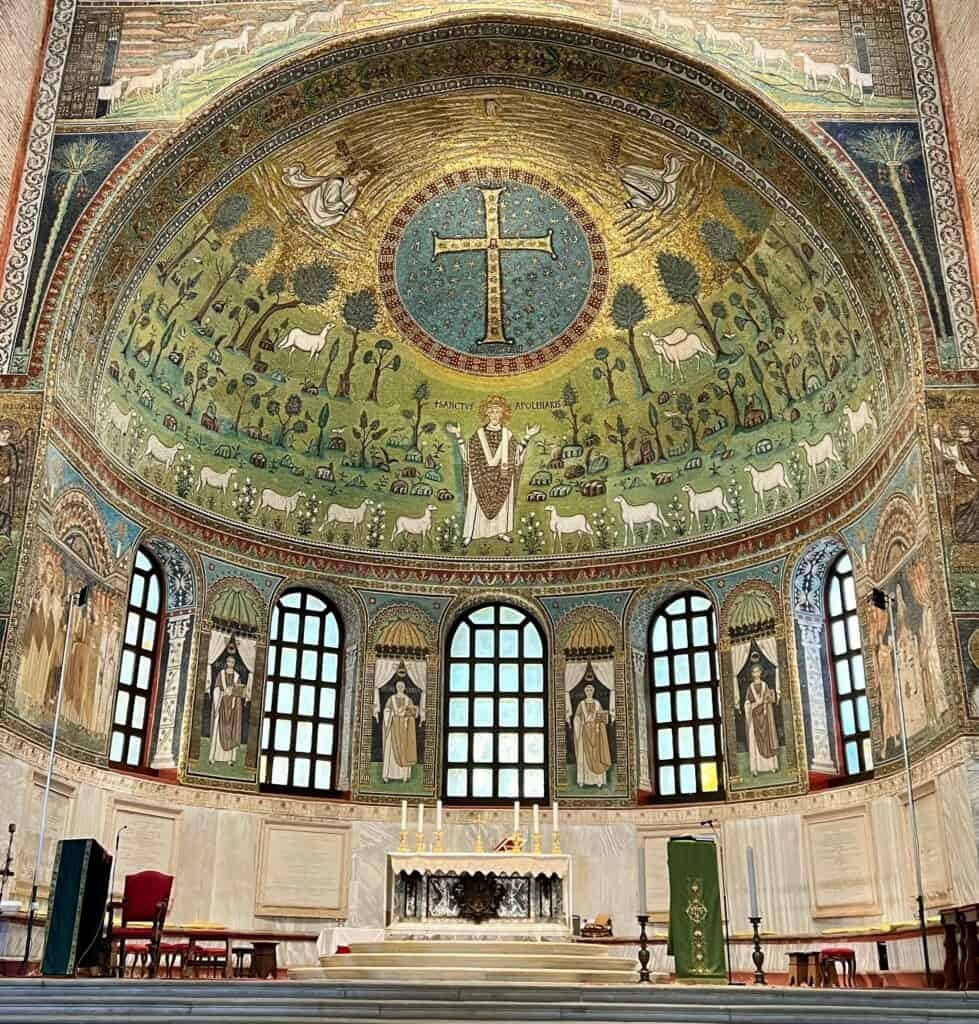
The old Roman port of Classe, adjacent to the settlement at Ravenna, got its own major church in the mid-sixth century. It was constructed at the same time as San Vitale, with funding from the same local banker. Unlike San Vitale’s centrally-oriented Byzantine floor plan, however, Sant’Apollinaire in Classe is a classic basilica with a long nave. The architecture is more spare here, with mosaics limited mostly to the end of the building. Pastoral greenery dominates the wide apse, with slivers of clouds squeezed into the golden sky.
lionsinthepiazza - by Mary and Sarah
Comments