Ukraine’s Monumental Soviet-Era Mosaics

Updated: Jan 1
by Claire Voon is a staff writer and reporter at Hyperallergic.
Often unremarked or dismissed as state propaganda, Ukraine’s Soviet-era mosaics are also artworks in themselves that speak to a complex history.
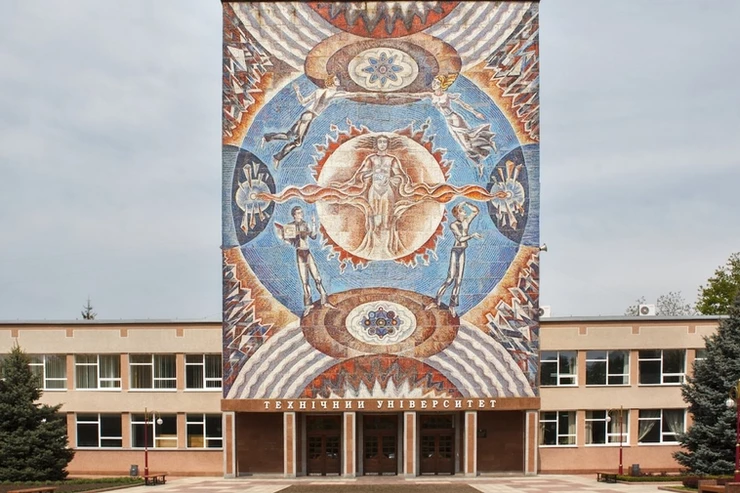
For three years, photographer Yevgen Nikiforov traveled across Ukraine with an ambitious mission: document as many surviving Soviet-era mosaics as possible. These monumental panels have, for decades, adorned the interiors and exteriors of buildings in nearly every town and city, communicating Communist ideals in intricately fashioned scenes. And many remain embedded in the walls of apartment buildings, post offices, schools, and other structures, even though Ukraine declared its independence from the USSR nearly three decades ago.
The result of Nikiforov’s diligent search is Decommunized: Ukrainian Soviet Mosaics, the first comprehensive photographic study of Soviet monumental mosaics in Ukraine, including the territories of Crimea, Luhansk and Donetsk (Nikiforov commissioned local photographers to photograph six mosaics in the latter two states). Published by DOM publishers in cooperation with OSNOVY Publishing, the book features about 200 photographs of mosaic panels, ensembles, and small architectural forms (like bus stops and border signs). They represent just a sample of the over 1000 mosaic pieces Nikiforov tracked down, across the 109 cities and villages he visited.

Designed and made by Soviet artists, most date to the last three decades of the USSR. They reveal a vast range, not only of topics — industrialization, history, folk motifs, leisure, and more — but also of styles and techniques. Ceramic tiles, colored smalto, and glittery designs embedded with glass shards or natural stone come together to portray heroic citizens, from focused factory workers to streamlined athletes to superhuman scientists who conquer problems allegorized as monsters. Many subjects are stylized, while some are more realistic; in one unique mosaic near the Kyiv River Port, rowers resemble the blocky figures of Egyptian hieroglyphs.
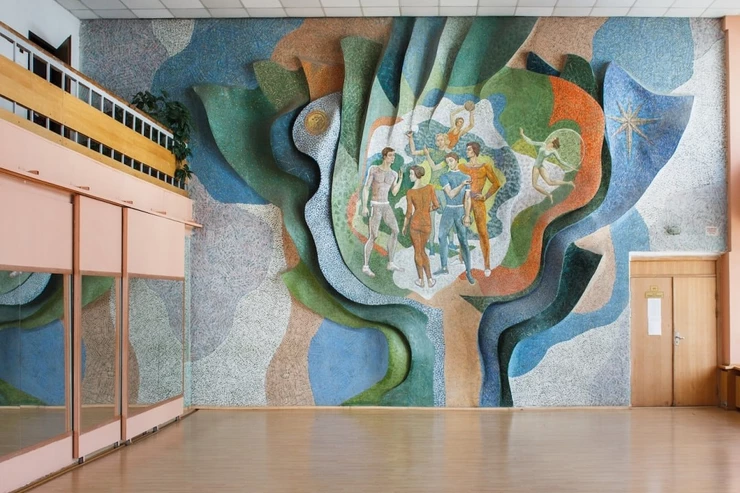
1977-1979 painting on relief by Ernest Kotkov at the National University of Physical Education and Sports of Ukraine, Kyiv, published in Decommunized: Ukrainian Soviet Mosaics(photo by Yevgen Nikiforov)
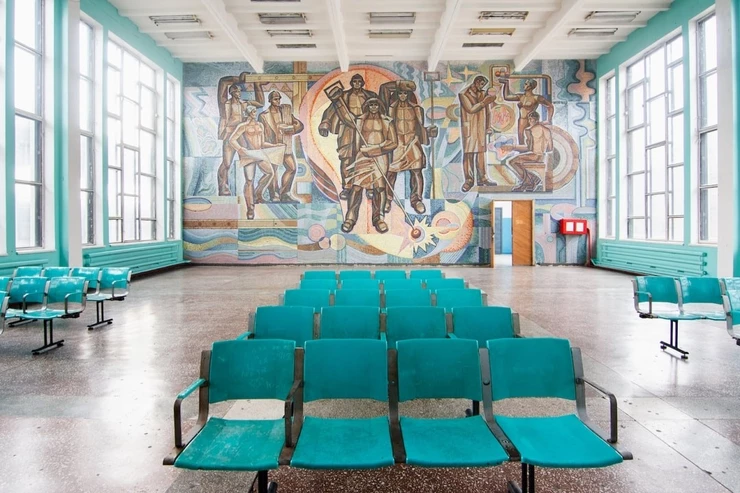
Mid-1970s ceramic mosaic by an unknown artist in the Dnipropetrovsk-South train station, published in Decommunized: Ukrainian Soviet Mosaics (photo by Yevgen Nikiforov)
Nikiforov began his search in 2013; while working on another project on Ukrainian artworks, he realized that little high-quality documentation existed of the Soviet-era mosaics in Kyiv, his hometown. He decided to begin photographing them himself, and the task took on a new urgency in 2015, after the Ukrainian government approved a decommunization law to remove public symbols of its Soviet past. An entire chapter in Decommunized features on mosaics that are no longer in situ, from ones depicting the hammer and sickle to many portraits of Vladimir Lenin.Paradoxically, as much money as the state put towards into hiring artists to create these mosaics, residents never recognized their artistic merit, as contributors Olga Balashova and Lizaveta German note in the book’s foreword.“Soviet monumental art failed to engage or enchant the public, both in the Soviet times and after Ukraine gained independence,” they write. “It was treated as state-commissioned propaganda, not worthy of attention.”

L. Sydorenko, A. Kotliar, “Lenin, The Banner of Generations” (1972) in the Municipal Palace of Culture, published in Decommunized: Ukrainian Soviet Mosaics (photo by Yevgen Nikiforov)

Alla Horska, Victor Zaretskyi, Halyna Zubchenko, Hennadii Marchenko, Hryhorii Synytsia, “Prometheuses” (1965) on School №5, Donetsk, published in Decommunized: Ukrainian Soviet Mosaics (photo by Valentyn Siniavin)
Nikiforov witnessed these attitudes first-hand during his cross-country journey. He recalls that, “The passersby marveled at my resolve to travel such distances to photograph blots on the wall or color shapes, barely visible for them. I was told, time and time again, that this heritage does not belong on the wall, that this is no art.”
With Decommunized, he argues that these colossal designs are, in fact, inherently artworks we should appreciate and preserve. Each of his photographs centers squarely on a mosaic piece as subject, not backdrop, and Nikiforov deliberately leaves out details like advertisements and AC units when possible. Further framing them as artworks are labels accompanying each image that detail each mosaic’s artist, date, location, and GPS coordinates. Some information is missing, but Nikiforov has clearly done his research to establishing basic authorship and history.

Alla Horska, Viktor Zaretskyi, Borys Plaksii, A. Smirnov (architect), “Coal Flower” (1968) at Krasnodonvuhillia Factory Management, Krasnodon, published in Decommunized: Ukrainian Soviet Mosaics (photo by Viktor Vlasov)

Stepan Kyrychenko, Roman Kyrychenko, “Red Army” (1984) at Palats Ukraina subway station, Kyiv, published in Decommunized: Ukrainian Soviet Mosaics (photo by Yevgen Nikiforov)
Just like the debates over the removal of Confederate monuments, discussions of decommunization have remained controversial. The photographer himself describes decommunization as “a logical stage in the political trajectory of our country,” but explains that there are different approaches to the process that don’t result in total erasure of valuable records.
“As a matter of fact, relatively few mosaics depict overly Communist symbols marked for destruction under the current law,”Nikiforov writes. “I believe that we’d do well to keep even those, granted that we provided them with annotations explaining the historical context. We shouldn’t cultivate ignorance and pretend that the Soviet period never existed.”

van Lytovchenko, “Creation” (1982) on a Strumok store, Pripyat, published in Decommunized: Ukrainian Soviet Mosaics (photo by Yevgen Nikiforov)

Ada Rybachuk, Volodymyr Melnychenko, “Magical Fiddle” (1963-1968) at Kyiv Palace of Children and Youths, Kyiv, published in Decommunized: Ukrainian Soviet Mosaics (photo by Yevgen Nikiforov)
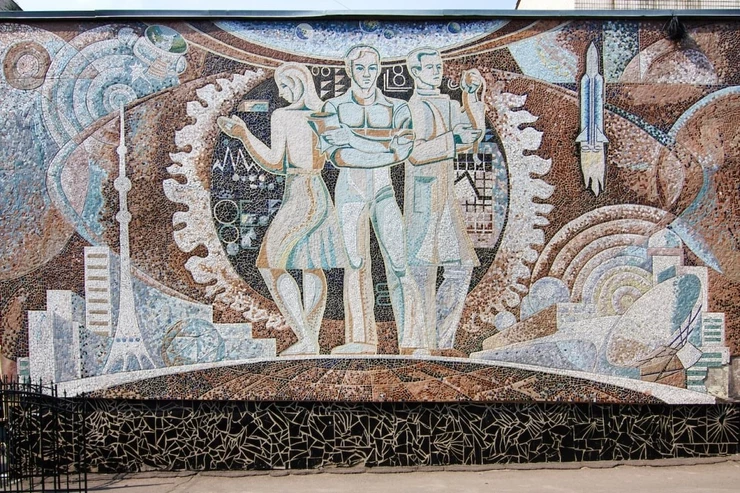
1980s ceramic mosaic by H. Soldatov on Vinnytsia Interregional College №4, Vinnytsia, published in Decommunized: Ukrainian Soviet Mosaics (photo by Yevgen Nikiforov)

Ceramic mosaic by Valentyn Kovaliov in Cheriomushky indoor market, Odessa, published in Decommunized: Ukrainian Soviet Mosaics (photo by Yevgen Nikiforov)

Colored smalto mosaic by an unknown artist at the Volodymyr Sosiura House of Culture, Lysychansk, published in Decommunized: Ukrainian Soviet Mosaics (photo by Yevgen Nikiforov)

H. Hvozdov, “Spatial ensembles” (1984) at Miskhor health resort, Loreiz, Crimea, published in Decommunized: Ukrainian Soviet Mosaics (photo by Yevgen Nikiforov)

Halyna Zubchenko, Hryhorii Pryshedko, “Blacksmiths of Modernity” (1974) at the Institute for Nuclear Research of the National Academy of Sciences of Ukraine, published in Decommunized: Ukrainian Soviet Mosaics (photo by Yevgen Nikiforov)

Berezhnyi, “The Land Of Winegrowers And Fishermen” (1970s) on a department store in Ochakiv, published in Decommunized: Ukrainian Soviet Mosaics (photo by Yevgen Nikiforov)

Unknown artist, “More Cast Iron, Steel and Rolled Stock for the Motherland” (1970s), published in Decommunized: Ukrainian Soviet Mosaics (photo by Yevgen Nikiforov)

Mosaic ensemble on 17-27 Premohy Avenue, Kyiv, published inDecommunized: Ukrainian Soviet Mosaics (photo by Yevgen Nikiforov)
Comments